
 Despite India’s consistent record food grain production, smallholder farmers endure income disparities. In response, the Indian government has shifted its agricultural policy, moving from just input subsidies to strategic capital investment to leverage technology and finance to de-risk agricultural production and digitally empower farmers, ultimately leading to higher incomes.
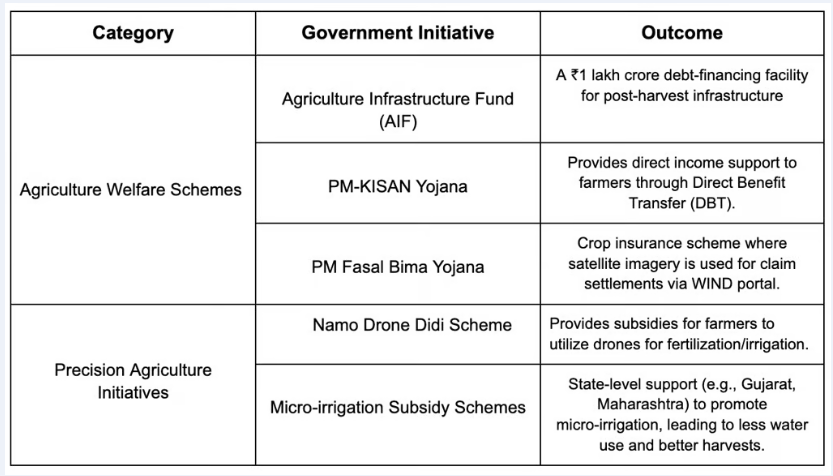
Government schemes drive financial empowerment A key initiative is the Agriculture Infrastructure Fund (AIF), a ₹1 lakh crore debt-financing facility that supports post-harvest infrastructure like modern warehouses and cold chains. To date, over ₹52,000 crore has been sanctioned through the AIF. Moreover, the government has allocated over ₹1.2 lakh crore annually to Agricultural Welfare Schemes, prioritizing transparency and efficiency to improve farmer income. Also, satellite imagery via the WINDS portal is utilized for accurate crop insurance settlements under the PM Fasal Bima Yojana (PMFBY).
Fostering High-Tech Innovation in Agriculture The digitization of Indian farming involves establishing a Digital Public Infrastructure by integrating farmer data, including Soil Health Card (SHC) data. Concurrently, market inefficiencies are being tackled head-on via the digital sphere. The e-NAM (National Agriculture Market) platform has digitally unified over 1,400 APMC Mandis, creating a pan-India electronic marketplace.
Agriculture in the Age of AI At its core, AI will empower a computer system to emulate an expert agronomist. This can be achieved through Multi-Modal LLMs, which are capable of interpreting data streams like drone imagery, satellite readings, and local sensor data. Computer Vision devices, can serve as the ‘eyes’ to accurately map crop health and pinpoint anomalies, and also, Robotics, providing the ‘hands’ for autonomous farming.
The rapid global ascent of Artificial Intelligence (AI) in agriculture, led by pioneering startups in the West. Sophisticated digital farm management platform enables autonomous field mapping and predictive analytics for inventory and market planning. Companies deploy GPS-guided robotic sprayers with computer vision to execute highly precise actions like spot-spraying pesticides.

Indian Agronomists must proceed with caution. Directly adopting advanced agricultural technology in India is ill-advised. Indian smallholders face unique challenges: limited land, high costs for robotic solutions, poor credit, risky markets, low profits, and nearly 40% harvest waste due to poor storage/logistics. AI-based innovation should involve adapting core AI (like LLMs) with local crop/disease data as above to provide expert advice via affordable mobile apps. Remote sensors will further enhance irrigation/fertigation, offer specific crop insights, and improve market access. To aid regular farmers, government policy necessitates developing indigenous AI, not replicating foreign ideas.