
India has invested heavily in physical security infrastructure. From smart city projects to CCTV networks protecting campuses and sites of national importance, the country has built an extensive surveillance grid. Yet the same question persists after every security breach: why did no one respond in time?
A Security Breach can be Fatal, Sometimes Costing Lives. The gap between a security event occurring and human intervention is measured in minutes at best, hours at worst. In high-stakes environments — like terrorist attacks— those minutes are consequential. In fact, one of the IITs faced a severe security breach when an unauthorized individual who was caught living on campus for weeks undetected.
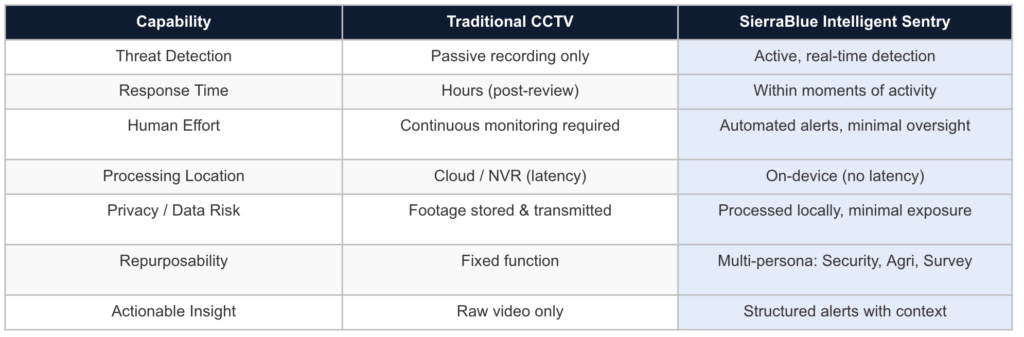
Traditional Approaches to Security are Failing. Conventional CCTV-based surveillance consistently fails to deliver real security outcomes due to three compounding factors –
1. The physiological limitations of human attention which sharply degrades after just 20 minutes of monitoring video feeds.
2. Routing footage through cloud services introduces an unavoidable latency that renders real-time responses impossible in low-connectivity environments.
3. Universities face significant financial hurdles in adopting enterprise surveillance systems with high licensing fees, server infrastructure, and ongoing maintenance costs.
Conventional Cameras only record. Today’s surveillance systems are built on a fundamentally flawed premise — they record everything but understand nothing. Cameras generate enormous volumes of footage that flood into control rooms, requiring human operators to watch, interpret, and respond. The Intelligence Gap lies in Perception vs. Recording. A camera captures photons. Perception requires understanding — the ability to classify objects, detect anomalies, infer intent, and generate a meaningful response.
SierraBlue’s Intelligent Camera Solutions for Surveillance. SierraBlue’s Intelligent Camera Solutions for Surveillance. The missing layer is on-device perception — a processing brain embedded in the hardware itself that detects and classifies what it sees the moment a frame is captured, in milliseconds, without waiting on a network. SierraBlue Innovations is building Brahmaksh, an AI-enabled perception platform designed to give physical devices their own eyes. It pairs a ‘Universal Core’ edge computer powered by an NVIDIA Jetson GPU with a cloud reasoning layer hosted on India-based, MeitY-empanelled infrastructure.
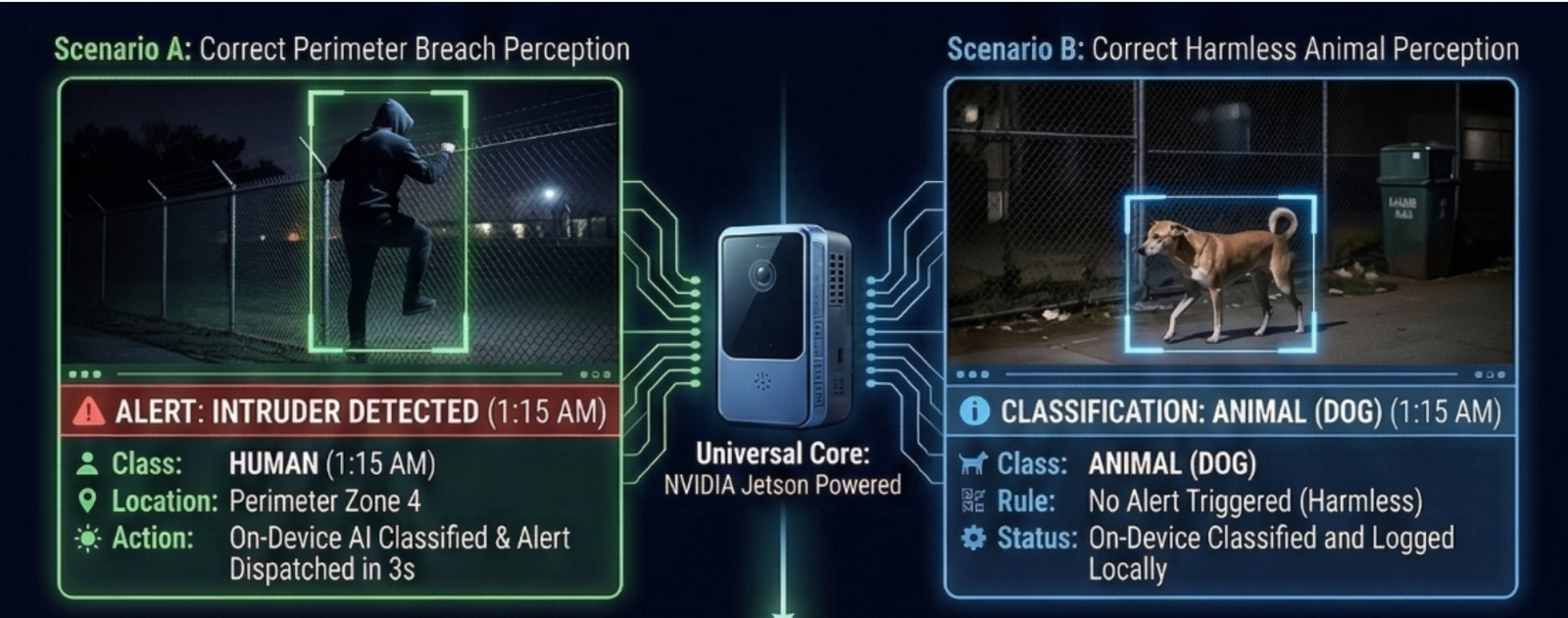
Brahmaksh uses contextual AI for real-time analysis, accurately identifying objects (person, car, animal) and distinguishing normal activity from potential threats. Instead of generic ‘motion detected’ alerts,
It provides detailed, structured reports—like an unknown person crossing a specific line and heading toward a building—including location, time, and confidence level.
It maintains functionality even in challenging conditions like darkness or poor network connectivity like remote state borders.
The result: threats are caught at the edge in milliseconds, reasoned about in the cloud within seconds, and only structured findings — never raw video — leave the site, processed on India-based infrastructure. Detection that works where the network doesn’t, intelligence that stays in India: that’s the Brahmaksh Surveillance Platform.